

A Pencil among us
First, some quick background:
There’s a write-in candidate for governor that has recently gained some real traction: a talking pencil. No, I am not joking. From the NPR article about them:
Picture a smiling office supply store mascot: Pointy lead tip just above its bespectacled face. Big yellow barrel of a body. Pink eraser down around the knees.
That’s Pencil, Oregon’s most unlikely gubernatorial candidate this year.
And when I say “recently gained traction” I mean, two people reached out to me about Pencil on Monday.1 To give you some context, unless Taylor Swift or the Mountain Goats drop a new album, I never have multiple folks reach out to me about the same thing. For better or worse, Pencil’s gone viral in my little neck of the woods.
So… I reached out. And Pencil’s campaign manager, J. Schuberth was nice enough to respond. I interviewed them yesterday.
Needless to say, this all came together very fast. I’ve posted the full interview below and I really recommend reading the whole thing, especially if you’re invested in K-12 educational outcomes, particularly elementary-aged reading. But, in the interest of readers who don’t have that kind of time, I wanted to put some of my key takeaways at the top.
Pencil is legit. I don’t mean legit as in “is a real candidate.” That they are not. What I mean is they know the problem, and the solutions, quite well. I am decently versed on the latest educational performance data and educational best practices and they know this stuff cold, way better than I do.
Pencil is right. In advance of the election, I don’t have time to fact check every one of Pencil’s claims. However, I can say:
Pencil is right that Oregon schools are performing poorly. 46th in 4th grade reading; 48th in 4th grade math. But it gets worse, adjusted for demographics, we are 50th in both. 50th as in last, in the country. 8th grade scores are better, but not by much.
This is partly a money problem, but it’s not only a money problem. Depending on the source, we are somewhere between 19th and 22nd in per student spending.
These are bad stats! We should be ashamed of these stats! We should be trying to fix them!
Pencil believes the problem is fixable. They are probably right. A lot of ink has been spilled about the “Mississippi miracle”, where Mississippi turned around their poorly ranked reading scores over the couple of decades, through a combination of phonics, teacher instruction, early intervention, and 3rd grade retention. A lot of states have adopted some or all of these strategies and seen meaningful improvements
Pencil is genuine. They say they’re just a dyslexic adult, with a dyslexic kid, who is simply pissed at how many of our kids can’t read. They also say this campaign is entirely self-funded. These claims look legit.
No one besides J has funded Pencil PAC, and they’ve put in ~$24k. Real money, but a reasonable sum for a well-resourced person with a passion project.
I’ve scoured FEC.gov and the dark money trackers and all of J’s donations match that of a lifelong democrat2.
That last part is important, because Pencil blames Kotek, and the broader democratic coalition (legislators, ODE, the teachers unions), for their inaction.
For those who remember the Obama-era Education Reform wars, this passes the smell test. Teachers' unions were the primary opposition to high-stakes testing and centralized accountability. (Whether you think that was principled resistance or cynical self-interest probably tracks with how you felt about the education reform movement broadly.)
The conceit (of a talking pencil) has got people talking. I respect the hell out of that in this attention economy.
I would love for Oregon to be number one in education. Pencil would settle for number two.
- J. Schuberth
So if you’re also unhappy with the trajectory of Oregon schools, consider the Pencil when you vote this week.
But first, a brief interlude with a real teacher
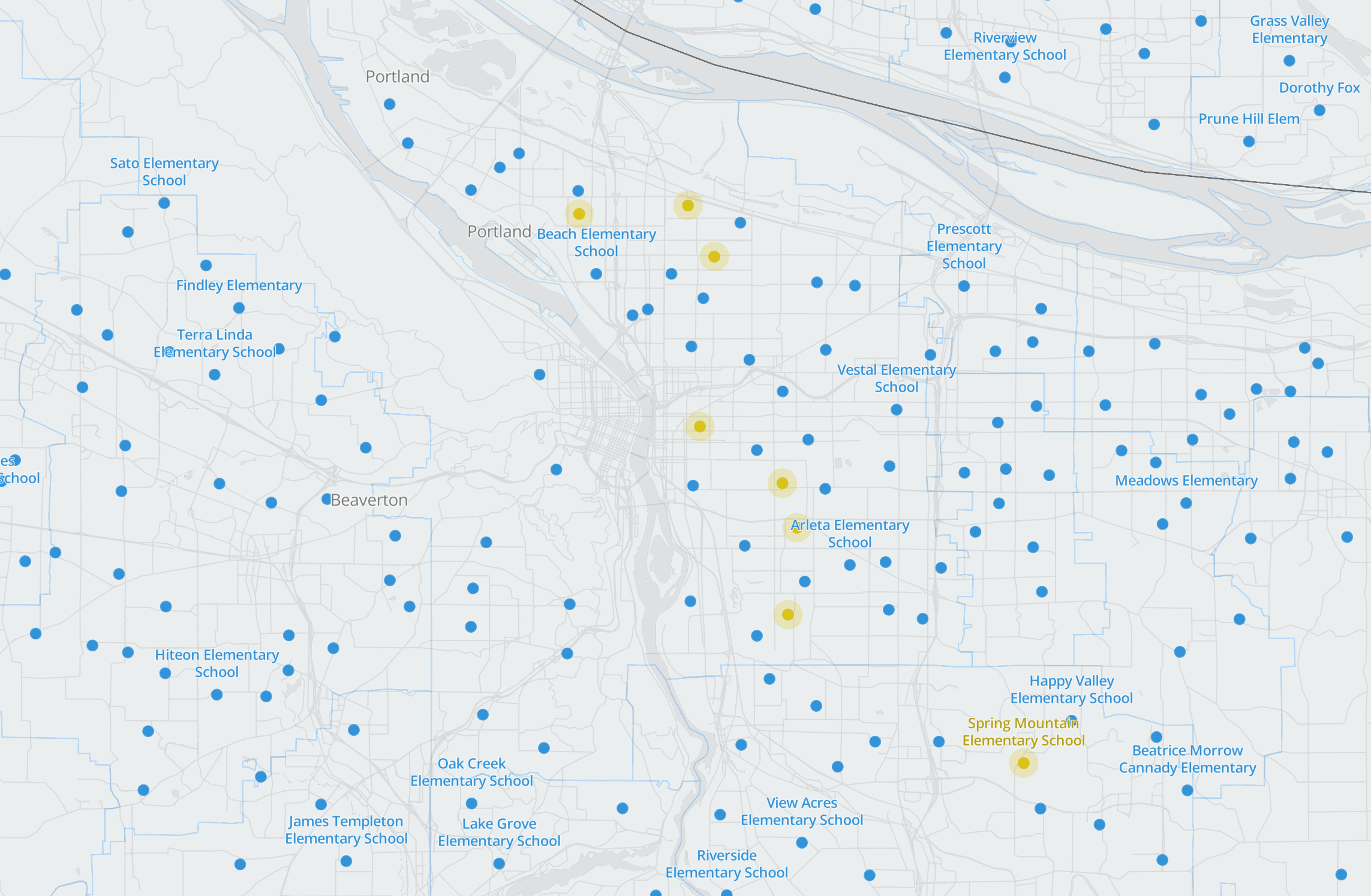
After I spoke with Pencil, I also talked on background3 with a teacher who works at one of the Oregon schools that is over-performing, identified as a “Bright Spot” by education outlet The 74 Million:
We calculated each state’s expected reading proficiency rate, based on its local poverty rate, and compared that to its actual third grade reading scores. This methodology helped us identify schools that are beating the odds and successfully teaching kids to read… These exceptional schools are in the top 5% of their state in terms of outscoring their expected reading proficiency.
I don’t want to over-leverage on one data point — test scores can be noisy. But this school has a pretty good reputation by word of mouth in the Portland community, so I’m inclined to think there’s something there when the data and anecdotes match.
What are they doing right? Interestingly enough, the teacher wasn’t sure! But, some things worth noting from this teacher:
PPS has really shifted towards a “Science of Reading” approach, with cross-school SoR study groups in the last 2-3 years and with a district-wide, district-mandated curriculum, comprised of:
Fundations for phonics, K through ~3rd grade
Heggerty for phonemic awareness, K and 1st (auditory skills)
Wit & Wisdom for English Language Arts, for K through 5.
There’s strong pressure from the district to ensure every classroom is teaching the same thing, even to the point where they want to remove non-curriculum posters from classroom walls.
Still, some of these curricula can be challenging to work with. Teachers have to adapt materials to make them age-appropriate for their class (e.g. Wit & Wisdom is super text heavy, which doesn’t make sense in, say, a Kindergarten class)
Even with that generalized pressure, each classroom is its own “biome” and accountability comes mostly from the school administration, rather than from the district as a whole.
I found the teacher’s perspective interesting. It suggests to me that Portland Public has already begun to take some of the broad critiques about K-3 reading education seriously, and they’re starting to implement some of the recommendations Pencil is pushing for. But, just as importantly, that implementation is happening jaggedly, and with gaps in quality materials. A green shoot, perhaps; one that could use some watering — especially at scale, statewide.
Now, on to the full interview:
Pencil 4 Gov: the interview
This interview was edited, mostly for clarity and a little for length.
Mort: Okay, jumping right in — give me the elevator pitch for Pencil.
J: Oregon is 50th out of 50 states in fourth grade literacy. That’s bad, I would say, and I think we can all agree on that. This is not a problem with our kids, with their parents, or with our teachers. This is a systemic problem, and that means we have to fix the system. The good news is it’s a fixable problem. Many other states have done things, and we just need to do those.
Mort: And for 50th, you’re basing this on the NAEP rankings?
J: The NAEP rankings, but it’s really important — there’s a group, and it’s linked on my website — that adjusts them for demographics. We’re almost last when you don’t adjust them, and we’re 50th when you adjust for demographics.
Mort: Is this a new problem post-pandemic, or have we been low for a while?
J: Not new. I got involved with advocacy before the pandemic, and then the pandemic hit, and we thought maybe people would realize we’d have to step up. It just got worse. We’ve been increasing spending in Oregon for many years and at the same time we’ve continued to see reading scores — and math at different levels — go down.
The other thing I’ll say — I’ve been here almost 20 years, and I remember the 40-40-20. You may not have been around for this. There was something called the Oregon Education Investment Board, and by 2025 we were going to have 40% of Oregonians with BAs, 40% with AAs, and 20% with high school graduation — meaning 100% graduation. That just came and went, and we forgot about it because we didn’t achieve it. That was around 2010-2011.
Oregon is very good at setting goals and then doing nothing to actually achieve them. The graduation number is something people have focused on as going up. A problem with that: we got rid of all standards for graduating high school during the pandemic and didn’t bring them back. Students are graduating unprepared. We know that because 40% of kids going to community colleges in Oregon have to take remedial courses before they take credit-bearing ones. Most never make it to credit-bearing.
Mort: There’s some data out of California4 to that same effect.
J: Yeah, the California one, especially in math — they’re a little shocking. We have this problem too in math. Our math scores — I can only fix reading right now…
The report you’re referring to was about students going into universities. You have to remember those are kids who got into a university. If they’re taking remedial courses, what do you think is going on with students going to community college, or not going to college at all? When you have it at the university level, that’s a red flag.
Mort: You seem to cite a lot of the Mississippi Miracle data on your site. Is that right?
J: Some, but go ahead.
Mort: You seem to have a belief this is a solvable problem and that there are particular interventions you’d recommend. Where are those interventions from?
J: Those interventions are from scientific research that’s been proven, and Mississippi and other states have implemented it.
Research shows 95% of children can learn to read if given proper instruction. What is proper instruction? Broadly, there’s something called “the science of reading”, or structured literacy, that people have probably heard about. After many years, we understand how people learn to read, and you can train teachers in it.
So, structured literacy. There are two levels. First: how do you get kids reading? We know how to do that. The science of reading is a huge body of literature. If you train teachers properly, especially when kids are young, and you provide tutoring for those who need extra help, 95% of kids can learn to read — across all demographics.
We’ve seen this not just in Mississippi. Out in eastern Oregon, Dr. Rhonda Fritz is doing amazing work going into schools training people. Within a year they’re doubling how many kids are reading at grade level. They’re doing this in Corvallis. There are tons of examples in Oregon. But they’re isolated, and usually depend on one or two people driving it. So the first part is: we know what to do.
The second level is political and institutional. Mississippi did this at scale for an entire state. What that takes — there’s an Oregon Department of Education, and then 197 separate school districts. In Oregon, we take the money, push it out, and say you can kind of do whatever you want with it. Almost no guardrails. Mississippi was like that. They were 49th, and they said this is unacceptable. They transformed their Department of Education from compliance-based box-checking to one that connected funding to outcomes.
First thing they did: they trained every K-3 teacher in the science of reading, then kept going with upper grades. Everyone got the same training. Second, teachers weren’t learning these methods in higher ed when they got their masters or BAs. So they retrained the professors too, so new teachers coming out would know how to teach reading properly, and districts wouldn’t have to spend money retraining them.
That’s two things on Pencil’s platform: train all K-3 teachers in the science of reading — not a one-day one-off. Eastern Oregon has an amazing program, takes a couple months, with coaching and facilitating. Colorado used it. It’s used in 12 other states. It’s already set up at Eastern Oregon University, and why we’re not using it, I don’t know.
Second: a licensure exam. When new teachers come out of their prep program, they have to pass an exam showing they know how to properly teach reading. We don’t have that in Oregon.
There will be children who struggle to read.
For students who struggle, there are usually two groups. One is someone like my son who’s dyslexic. I’m also dyslexic. I paid thousands of dollars for tutoring, and now my son’s going to college next year. That’s what you need for students struggling who may have dyslexia.
The other group is multilingual learners. The way our brains work — if you’re trying to learn English and reading, kindergarten and first grade is this magical point where if you give tutoring during that period, extra of the same science of reading, just more of it — they have to hear the phonemes. A letter is the letter A. A phoneme is /a/, /ā/. It’s the sound.
The second thing Mississippi did was bring in extra tutoring and help for kids who needed it. You save so much money this way. If you can get kids reading by third grade — Johns Hopkins did a study in Massachusetts across special ed, multilingual learners, all the demographics racially and SES — after a year of good instruction plus tutoring, two years later they were still at grade level. There’s a magic moment, and you save tons of money later.
The third thing — this is what no one talks about with Mississippi, and it scrambles all politics — Oregon is the 48th most regressive state in funding high-poverty schools. Sit with that for a moment. Liberal, progressive people, especially Portlanders with this image of themselves — 48th most regressive. Mississippi doubles down and sends more support, more literacy coaches, to schools doing worse because they have more children struggling. They don’t punish you. They say, we’re going to help you. That’s why they’ve made such progress.
In Oregon, the governor could change tomorrow how we calculate funding. They’re using an estimate rather than a real count of poverty, and it’s basically robbing schools and districts with higher poverty of hundreds of millions of dollars, and has for a couple years.
Mort: Is that just an accounting issue? Because I’d think Measure 5 and 50 and how we calculate property taxes would have pretty dramatic impacts too.
J: No, it’s not. Some people will argue this — we’re 19th in per-pupil spending. These are averages, and that’s what’s so hard, trying to understand how money actually comes in and goes out of the state. But you can right now look up on the Oregon Department of Ed website per-pupil spending for every school, and it’s thousands of dollars different for someone in Lake Oswego or PPS than someone in a rural school. That is not based on property taxes.
The money coming in and going out is calculated by a formula. About 75% of a school district’s money comes from the state, the other 25 is local — levies and so on. In that state formula, they use an estimate of how many kids are living in poverty, and it’s way under what the actual is if they used what almost every other state uses. There are articles on this. Salem-Keizer hired a private consultant to show they’re owed hundreds of millions. The governor could change that tomorrow if she wanted. It’s not about legislation.
Mort: Stepping back — one thing not on your platform that’s part of the Mississippi law is holding back third graders who can’t pass the year-end reading assessment. Is leaving that out intentional?
J: Very intentional. Step by step. If we put that on, it’s the only thing people would talk about. And the research is — these other things are way more important than third grade retention. Retention can be important, but when you look at how many kids are actually held back, it’s very few, because no one wants to hold kids back. So it acts as a reminder. That said, plenty of parents have told me, I would want my kid held back. They ask for it. They call it social promotion, just being pushed through.
In Oregon we can’t even get to that conversation right now. And I’m also not convinced from the research. Mississippi did a whole bunch of things and people focus on retention, especially liberals. It’s probably not as important. There are other places doing really well helping students who don’t have third grade retention.
Mississippi started this and everyone talks about Mississippi. The truth is Mississippi laid the groundwork and then a bunch of other states started doing things. So now we have 20 years of research to look at: what did the states do, what do they have in common? What they have in common are the things I laid out.
Mort: So your argument is that’s politically — I wouldn’t say toxic, but politically… interesting — and not a bridge worth crossing because of the data.
Is it that the data isn’t compelling for retention, or that you want to do the other stuff first because the other stuff is more valuable?
J: When I look at policies — who’s making gains — not all of them have third grade retention, but all of them have these other things. That tells me those things are most important. Colorado doesn’t have third grade retention and is making gains because they trained all the teachers. When you’re trying to change a system, you focus on the things you have the most research for, where you can make the argument: these are the levers that move things.
I have to say, I have kids. If my kid couldn’t read in third grade I would have held them back. But I had thousands of dollars for private tutoring. Most people don’t.
Mort: My understanding is you’ve met with some folks in the Oregon government. How has that gone?
J: Which folks? I’ve also talked to people in other states. Like you, I decided — I used to be an academic, I like research and data. I’m a policy wonk. I read all the policies and called anyone who would talk to me — people who wrote them, implemented them, or got them passed in legislatures, from North Carolina to Mississippi to Colorado. People will talk to you. It’s amazing. I brought some of them in to talk to our legislators, including people from Mississippi. Basically they said, no thanks, we’ll do it the Oregon way. The Oregon way means 50th out of 50.
Mort: Can you be more precise? In what ways did they argue about particular approaches?
J: Yeah, and I’ll talk about stuff that’s on the record. What I’ll say is — what I’ve been most disappointed by in Oregon legislators, and we need to say this out loud: I’m interested in kids reading, but I’m also interested in power. The people who have the power to change this system are Democrats, and we need to be clear about that, because they’ve been in power 20-plus years with supermajorities. This shouldn’t be a partisan issue — everyone would say kids should read. But the supermajority here has really hurt Oregon. Behind closed doors, people agree with us, they get it, and then they turn around and don’t vote for things that would actually change anything. That has a lot to do with a supermajority in one party.
Things in the public domain — if you watch an Education Committee meeting, last year they brought in people to discuss how far behind we are. A Georgetown group presented to the House Education Committee showing a huge increase in funding and resources to the Oregon system, in real dollars and per-pupil (19th out of 50), with bad outcomes. Instead of asking what the problem is, people like Representative [Ed. note: Senator] Lew Frederick said something really disparaging about Mississippi, that he had relatives there and it wasn’t as great as people were saying. That comes up a lot. “We should focus on what our kids are good at.” Which is a strange response! Sure, kids are great at a lot of things, but if they can’t read, you’re setting them up for a really difficult life.
That’s the Ed. Committee!
A few people have asked the right questions. Boomer Wright, Republican. McIntyre, Republican. Representative Ricki Ruiz, Democrat, has been amazing — he pushed for the summer dollars to be used only for literacy and got huge pushback… Janeen Sollman
Do you know what’s going on with Senator Sollman?
Mort: No.
J: Basically, we’ll see what happens. May or may not be a senator next week, because she’s being primaried by someone backed by the OEA — the Oregon Education Association. There’s an article about how she felt bullied by them. She’s one of the strongest supporters of measures with Ricki Ruiz on literacy. She also pushed back on the new policy where, in Oregon — the only place in America — workers can now get unemployment while on strike. Her argument was that puts districts at a real disadvantage; it makes striking much easier. A series of things that I’d say are what we need to start doing, and she’s being primaried by the OEA for it. So when we have these conversations with legislators who want to make change, we know they’re up against this.
The governor’s office — she said education was one of her three top priorities. She hired two people to run education on her behalf. One had no background in education. This was in her first two and a half, three years. That’s a strange signal. When that person is arguing with experts we’ve brought in from other places, or from people in the state, and it’s clear they don’t understand education or basic policy — that’s been our experience.
We also, in 2023 — I don’t know how deep you want to go — I wrote a bill based on conversations with everyone. The bill they put forward, the 2023 literacy bill, and now this accountability bill, are jokes. I showed them to people in other states and they were like, what is this? Who wrote this? I don’t know where they pulled some of these ideas from. When we challenged them, they couldn’t even come up with places. Another example — when they looked for literacy frameworks, they brought up a bunch of states. Mississippi wasn’t there. None of the states with good outcomes were on it. They were using Alaska and others. We’re not even sure if the people we’re engaging with are engaging with the latest research.
This is not a problem with our kids, with their parents, or with our teachers.
This is a systemic problem. - J. Schuberth
Mort: So from your perspective this is a coalitional problem — for whatever reason, part of the Democratic coalition isn’t engaged in this, or doesn’t see it as a problem. Fair?
J: No, I’ll be much more frank. The teachers’ union — and let’s separate that from the teachers. Teachers are education. Anyone who wants reform, this is not the teachers’ fault, the kids’ fault, the parents’ fault. But teachers are not the same thing as the teachers’ union, and the teachers’ union here is one of the strongest in the country after Illinois. They call it the alphabet letters in Salem — the OEA, plus COSA, the Coalition of School Administrators, plus the Oregon School Board Association. Those three groups oppose anything against “local control” — which is not a legal issue, it’s a cultural idea. Mississippi has local control. They’ve said: you can’t tell us to do anything. When we were in Salem, people would say, don’t say “accountability,” don’t say “mandate.” And it’s like, no — you have to mandate some things. The state gets to tell districts what to do. Those groups have been very much against that, and it’s hurting children. It’s also hurting teachers. Teachers want to succeed, they want and deserve this training. Whenever we do trainings with people, they’re like, oh my god, this is phenomenal. Then they get very upset — I’ve been teaching ten years, I can name the children I could have helped. Why did I not get this training? They’re angry and ashamed.
To answer your question — the problem is there’s a teachers’ union, and there’s no parent and child union. It’s supposed to be representatives and the governor. They’re shirking their responsibility. If you read the new accountability bill — Dr. Christine Pitts has written really well about this — they point left and right. The state says it’s the districts, the districts say it’s the state. If you’re a parent, you’re like, what? You can’t have shared accountability. You have to have a place where this is what we’re doing, and if you’re not doing it, we’re intervening. The new accountability bill is a joke.
Mort: I’ve got two final questions. What does success look like for Pencil? Because Pencil will not be the next governor.
J: As you would say.
Mort: I would say that with 99.9% confidence.
J: Actually true — I checked with the Secretary of State. An inanimate object cannot be the next governor.
So — why am I dressing as a pencil with my free time and resources? I want people to get this message, and we’re already there. I can’t tell you how many people didn’t know we were 50th, but they know something’s deeply wrong. Parents are asking, what is going on? People are asking about the money — we have record money, where’s it going? Which people need to ask, because this budget crisis everyone’s having — there’s another way of looking at it as a lack of accountability. They spent money they knew was one-time funds, and they haven’t been right-sizing for many years.
Success looks like people connecting their own experience with the system. This is a systemic problem, and the state has to solve it — it can’t only be done at the district level. Second, I want people to know this is not parents’, teachers’, or kids’ fault. We’re getting that across. And I want people to feel we can actually change this — because that’s what we’ve lost as advocates. I’ve been at this seriously for seven years; I have friends who go back further. There’s a sense we can’t change anything, it’s just like this.
I met with a representative and brought up — maybe we need a single curriculum, the state can buy it, it’s much cheaper, you train everyone in it, then we know what everyone’s using. Instead, 197 school districts using all kinds of stuff. He responded, oh, that’ll never happen, the districts will never let it. My response was: you, legislator, and the districts work for me, the citizens, and the children of Oregon. We built this system, and we can change it. We have to believe that. That’s what Pencil is trying to succeed at. That said, I would love for Oregon to be number one in education. Pencil would settle for number two.
Mort: As DeRay Mckesson always likes to say, these systems and structures are built by people.
Okay, my final question is off the beaten path. Your scholarly work — you clearly know a lot about education, but your scholarly work is actually in...
J: Medieval mystics?
Mort: Marguerite Porete — she was burned in 1310 for arguing the church couldn’t mediate the soul’s relationship with God. To what degree do you see that in your candidacy, if at all?
J: Oh my god, what a great question — you win for great question. Yeah, she was someone willing to speak truth to power, and she got burned for it. I don’t think they’re going to build a pyre and burn Pencil anytime soon — although I’d go up pretty fast. It’s wood, and the costume isn’t natural fibers either.
The other thing I studied was Foucault’s later work, which is about speaking truth to power. About using your own position and risking it, saying the thing out loud. What I’ve always been interested in is why people don’t. I’m fascinated by that. I’m someone who’s never been able to keep my mouth shut.
It hurts me to see the system failing children this way, and I’m compelled to do something. Over the years, that question — why some people go along with what everyone else is doing and others don’t — is a lot of what my scholarly work has been about. Especially when there are costs.
That’s also what’s weird — people send me nasty emails, say weird stuff on Facebook, but there’s really no cost here. And that puzzles me too, about the legislators. They won’t be re-elected, but — why won’t some teachers speak up, or principals, or other people in the system? If you care about children, that’s what we need. More people speaking up. And you’re not going to lose your job, because you’ve got a great union.
Mort: That's it. That's what I've got.
J: That's awesome. Well, thank you for taking an interest in Pencil, but really in education. I'm not a politician, I don't want to be a politician. I write crime novels now, that's what I really do. I'm a printmaker who writes crime novels. I'd rather be doing that than dressing up in a silly costume, but my conscience won't let me.
Mort: You're a parent, and you're passionate.
J: A parent with resources, though. My kids are fine because I paid a lot of money. That's what's so hard. My partner works in addiction with men coming out of or going into the prison system. Most of them struggled to read. I'm so aware — I'm dyslexic. I have a PhD from the University of Chicago. My mom had been trained on the west side of Chicago in a phonics method, and when I couldn't read at the school I went to, she tutored me. I didn't know I was dyslexic until I was 26, trying to study for my exams at Chicago. I wasn't getting through them fast enough and almost dropped out — I was like, how are people getting through all these books? They said, you're dyslexic. I was like, that's weird. Then I realized what my mom had done. If she hadn't — I mean, this is dumb luck.
Thanks for making it to the end! Kudos to you, dear reader.
Shout out to Patrick and… Patrick. (Both tech guys sporting facial hair. My friend group at its most diverse.)
I won’t deadname anyone here but from what I can tell J has been donating under a couple of different names, since at least 2018, to national figures like Joe Biden, Bernie Sanders, and AOC, and to local candidates like Kate Brown, Tina Kotek, and Rob Nosse.
Running an actual interview? Talking to folks “on background”? Is Mortlandia a real outlet for journalism? The idea frightens me as much as it does you.
UC - San Diego report. Press about the report: The Atlantic, Forbes, The Argument