
“I’m driving, here I sit, cursing my government
For not using my taxes to fill holes with more cement”
- Twenty One Pilots, “Tear in My Heart”
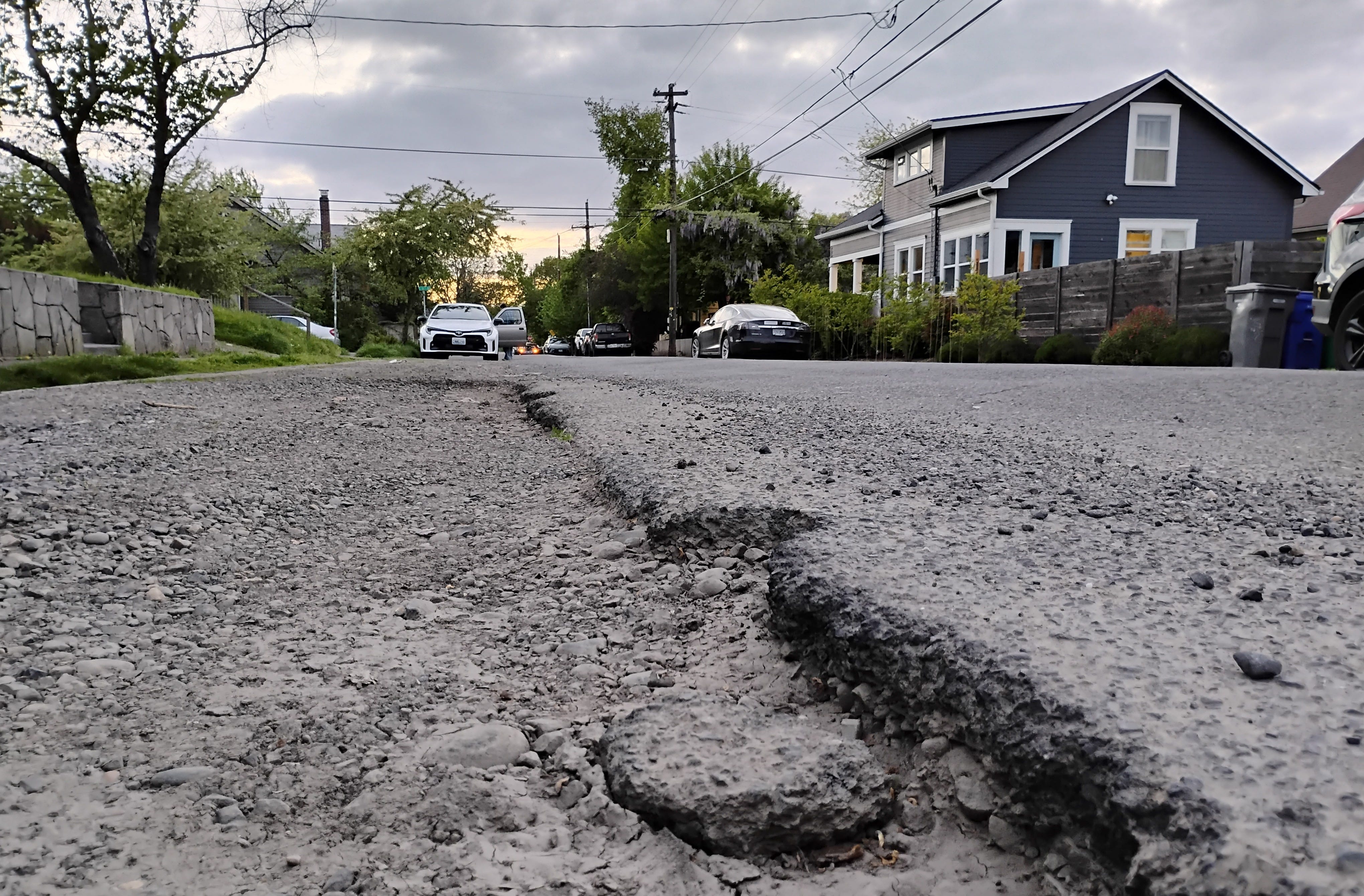
Election season! Let’s get right into it with the biggest ticket item.
Measure 120
What is it?
It’s a measure that increases fuel taxes, registration/title fees for roads, and a tax on wages for public transportation services.
Here’s a nicely formatted table with everything that matters
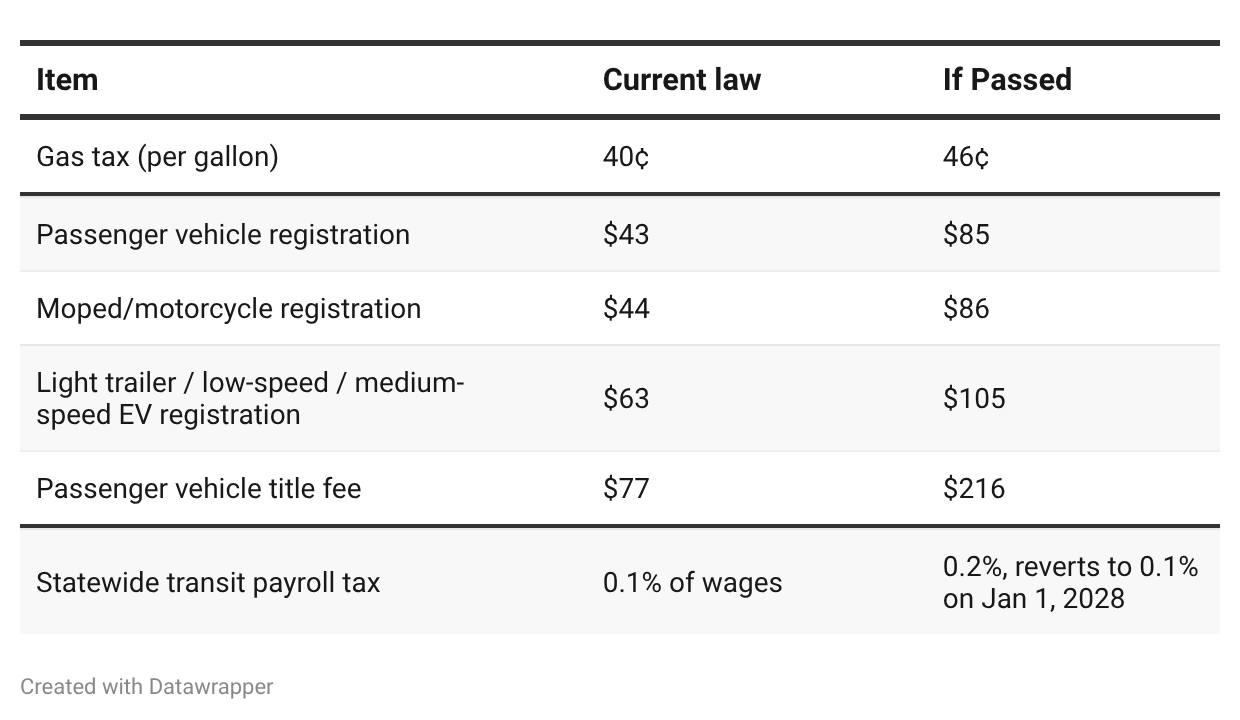
What does this net out to, in practice? Estimates vary and the math gets messy depending on whether or not you have a car, how much you make, etc. But realistically, it’s in the $50-$250/year range during 2026 and 2027, dropping to $20-$140/year beyond that.1 Assume closer to the top end if you're a high earner with multiple cars, closer to the lower end if you're not.
The gas tax and the title/registration fees are constitutionally mandated to go towards road projects and maintenance. That money is split 50/30/20 between the state, counties, and cities, respectively. The payroll tax portion goes toward public transportation. For the purposes of the Mortlandia readership, that basically just means TriMet but other cities get money too, mostly in support of their bus systems.2
Why is it on the ballot?
This is where it gets messy.
Oregon, like most states, historically has predominantly paid for its roads through gas taxes and other user fees. That mostly worked, for a time. But fuel efficiency across all cars and trucks have been rising for decades (Thanks Obama), which means each gallon taxed has to pay for more miles of road wear. Roads don’t degrade linearly, either. So you can defer maintenance cheaply for awhile but once roads get bad they get really bad. We’ve been deferring maintenance since at least 2019, likely well before. That bill is coming due.
Meanwhile, the gas tax is not indexed to inflation. Couple that with rapidly rising construction costs (due to — you guessed it — inflation) spending has quickly outpaced revenue. Add, again, cost overruns on mega projects (rose quarter expansion, for example), and you can see how we get here, from a structural standpoint.
To add insult to injury, in the 2023-2025 budget, ODOT made a $1B forecasting error on expected federal funds, which has, fairly or not fed a narrative of agency mismanagement."
So yeah. That’s why we need the money.
But that doesn’t explain why it’s on the ballot. It’s on the ballot because back in June of 2025, the legislature tried, and failed, to pass a comprehensive transportation package called HB2025. Weeks later, when ODOT layoff notices went out, the Governor scrambled via a special session and the legislature did pass a watered down version of HB2025 called HB3991, one that the more suburban and moderate members could stomach.3
HB3991 did lots of things. Of note, it:
Raised the gas tax
Increased title and registration fees
Temporarily raised the payroll tax
Changed the governance structure of ODOT
Added a mandatory usage charge (RUC) for EVs and hybrids
Added a +$30 fee for vehicles that get +40mpg
Repealed the statutory authority to add tolls (to I-5 and I-205)
Did a bunch of other wonky things, like making diesel gas taxed at the same rate, changing tax rates for trucks, adding biennial performance audits, etc.
After HB3991 was passed, a coalition of the anti-tax crowd rose up and got ~200,000 signatures (more than twice what they needed) to send items 1, 2, and 3 to voters as a referendum, leaving the others (4 through 8) enshrined into law.4
Measure 120 is that referendum, on those three things.
Like I said. Messy.
How am I voting?
Oregon's roads are funded almost entirely by drivers, more so than most states. (In Oregon it’s ~80%, in Washington it’s ~55%.) And that model continues to make sense, but only if we update it to reflect the realities of today’s costs and today’s revenues.
In my perfect world, we’d treat gas taxes + title/registration fees as both a user fee and a Pigouvian tax. While everyone should share some tax burden for the roads (emergency services need to be able to get to everyone, after all) the burden should fall heaviest on those who put the most wear on the roads. And because there are distinct negative externalities to internal combustion engines (more global warming and more health impacts from the air pollution they create), gas taxes are pretty elegant as a nudge toward more efficient vehicles. In other words, heavier and less efficient vehicles (trucks, SUVs) should be paying more than smaller, more efficient cars.5 Because while a 4,500 lb pickup truck (Toyota Tacoma) is only 45% heavier than a hybrid sedan (Toyota Prius), it does 4.4 times the road damage. Even factoring the fact that it is much less fuel efficient (~21 mpg vs. ~50 mpg) and thus paying twice the gas taxes, the math is still weighted (hah!) in the Tacoma’s favor. They only pay 2.4x the cost for 4.4x the wear and tear.
And to be honest, even before the referendum, HB3991 didn’t solve this. Far from it. By including the flat, per-mile road usage charge (RUC) and the high-efficiency surcharge, we were still overcharging small and efficient vehicles compared to their bigger, dirtier brethren.
But the way the Measure 120 is structured, voting ‘No’ just makes the problem worse. Backers of the referendum only included the provisions they didn’t like — the gas tax, the title fees, the desperately needed money for public transport — and let the rest come into effect. They got all their carrots (changing the ODOT governance, making I-205 tolling more difficult) without any of the sticks.
That really grinds my gears.
Voting ‘No’ also leaves us with a gaping hole in the budget for this year, a bigger one for next year, and a worse negotiating position to ever get transportation right.
The 2026 Legislature already preemptively rebalanced ODOT's budget assuming Measure 120 fails by raiding $218 million from previously-funded projects like Safe Routes to School, community EV charging rebates, and grants for port and rail improvements. Those projects don't happen if 'No' wins. They do if 'Yes' wins.
I’m not here to defend ODOT or ODOT’s budget. It’s pretty clear they’ve made some pretty big mistakes. But the ODOT governance is changing whether we vote ‘Yes’ or ‘No’.
Nor does voting ‘Yes’ solve the structural problem with our transportation funding. I think that will require some innovative thinking. I would propose, for example, moving to a weight-based RUC, to accurately track wear and tear.
Voting ‘Yes’ prevents the big scramble to cover the transportation funding. And it will help avert many of the planned TriMet service cuts. Voting ‘Yes’ merely a stop gap, but it’s one step closer to the big structural change we need to actually fix our roads. ‘No’ is two steps back.
I’m voting ‘Yes’ on Measure 120.
A silly post-script!
I intentionally pushed myself to release this endorsement BEFORE the Willamette Week, Oregonian, or Portland Mercury dropped their editorials. This was mostly for myself, because I didn’t want their opinions to color mine. But also, while I’m here, I’m going to play the prediction game!
Predictions for Measure 120 (Gas Tax)
The Oregonian: No — confidence, 60%
Portland Mercury: Yes — confidence, 90%
Willamette Week: Yes (but grumpily, with caveats) — confidence, 70%
Predictions for Measure 26-261 (Oregon Historical Society Levy)
The Oregonian: Yes — confidence, 90%
Portland Mercury: Yes — confidence, 95%
Willamette Week: Yes — confidence, 75%
Mortlandia: ??? — check back later this week to find out.
It drops after two years because that’s when the payroll tax sunsets. If you read the beautifully formatted chart closer, you would already know that.
I could write a whole process post on why this is so confused and confusing and how we got to this point and it would take me hours and be super fascinating for 5% of my readers while it would put the other 95% of you to sleep. Maybe some day I’ll write that post. If you want that post, shout out in the comments. In the meantime, I’ll spare you the details.
There was also a big to-do about the date of the referendum—roughly speaking Republicans wanted it in November, Democrats in May—but in the end the Dems won that fight.
We should also tax the shit out of studded tires but that’s a subject for another day.