
Good news can be tough to find in a town where the 2025 word of the year was “Doom Loop.” But courtesy of PBOT, we had some legitimately good news drop late last year.
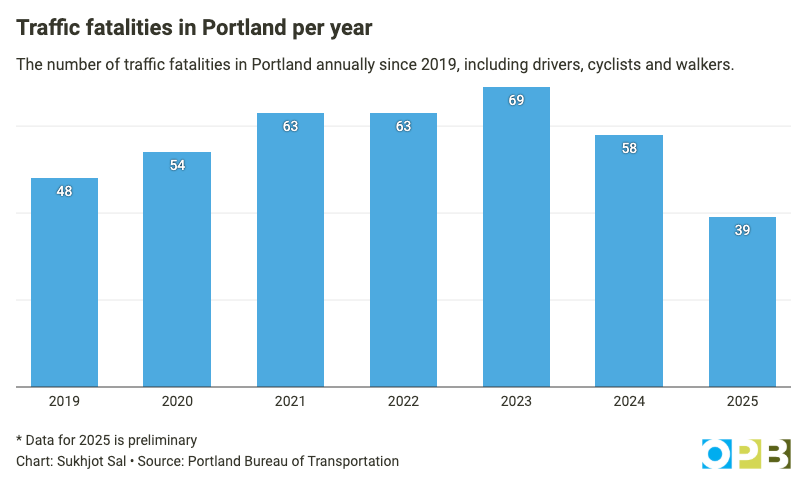
After spiking over the course of the pandemic, traffic deaths in Portland are back to pre-pandemic levels, at ~40 per year. Per OPB:
Local transportation leaders have attributed the drop to multiple factors, including greater awareness, increased infrastructure funding, more traffic cameras and an overall change in driving behavior since the pandemic upended people’s lives.
Assuming current trends persist, we have about 6 deaths per 100k residents, which is actually pretty good for a city of our size, though still well behind our perennial rival Seattle.1
At a macro level, “back to pre-pandemic levels” truly is good news, especially compared to what we saw in 2020 - 2024. But there’s also a reason “zero” has always been the goal of Vision Zero. At the individual level these were 39 real people with families and futures and dreams.
I Was Promised Flying Cars
What if I told you there was a way to further reduce traffic deaths by ~91%?
You would probably say “we should do that!” or, perhaps, “what’s the catch?”
Well, there’s a way to reduce traffic deaths by ~91%. And the catch is that there’s no driver.
We are, of course, talking Autonomous Vehicles a.k.a. AVs.
I won’t go through all the evidence for these claims. Lots of ink has already been spilled on it elsewhere. The data mostly comes from Waymo itself after >100M miles driven but independent researchers have verified that the data is credible. Feel free to read up on your own here:
Waymo’s own Safety Impact Report (Updated Dec. 2025)
Comparative performance of AVs vs. humans based on insurance claims (Jul. 2024)
Understanding AI’s analysis of every Waymo crash (Sep. 2024 & 2025):


Suffice to say, I have read most of this analysis and I find it pretty convincing. Your mileage may vary. I should note a few caveats:
I only find AV safety data credible for Waymo. Tesla’s approach to AVs has been pretty fast and loose (though sometimes hilarious). Tesla’s AV software is not yet safe enough for my comfort. Meanwhile, Cruise had to shut down after they lied to investigators. There are other AV companies who seem solid (looking at you, Zoox) but they don’t have a robust enough track record for me to endorse them quite yet. In short: we have a more-than-promising proof of concept in Waymo but we can’t trust players across the industry outright.
We’re almost two decades into AVs and we’re still in the middle innings. Waymo is just starting to scale beyond their initial markets. They’ve been operating autonomously since 2020 but only started driving paying passengers on the interstate two months ago! The impacts of AVs in new cities, on other drivers’ behavior, and on the built environment itself is still uncertain. Waymos appear quite a bit safer than human drivers but there may be second order effects (positive or negative) that we won’t fully understand for some time.
Still, we are far enough along that I am ready for Waymo to pilot in my community. The promise of genuinely safer streets is hard to ignore. To quote a recent NYTimes Editorial (emphasis mine):
In medical research, there’s a practice of ending a study early when the results are too striking to ignore. We stop when there is unexpected harm. We also stop for overwhelming benefit, when a treatment is working so well that it would be unethical to continue giving anyone a placebo. When an intervention works this clearly, you change what you do.
There’s a public health imperative to quickly expand the adoption of autonomous vehicles.
That seems right.
So what’s between you and a Waymo ride down Burnside? Let’s figure it out.
Does Waymo want to be in Oregon?
As of writing (Jan. 2026), Waymo operates in 6 major cities: Phoenix, San Francisco + San Jose, Los Angeles, Austin, and Atlanta. They’ve announced commercial service launches for 12 additional U.S. cities by the end of the year and they’ve been doing driver testing in at least 10 more beyond that.2
Portland is not on any of these lists.
Why not?
The best way to determine if it’s viable for Waymo to operate in Portland would be to look at existing rideshare volume. Unfortunately, that metro-level data is proprietary and Uber and Lyft both hold it pretty close to the chest. So for fun, I put together a toy model3 with the following inputs:
Market Size (by population for the metro area) [40%]
Median household income (a proxy for ability to pay) [40%]
Downtown parking costs (a proxy existing auto costs) [20%]
Here’s the result:
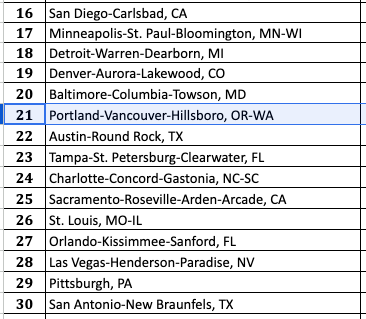
It’s obviously a bit imprecise but according to my model, Portland metro should rank 21st in terms of market opportunity. Across the top 30 markets in the model, Waymo is publicly making moves in 26 of them. So, in theory, Portland should be “worth it” for Waymo.
Looking beyond economics, with Waymo announced in Seattle and launched in San Francisco, there shouldn’t be particular concerns around weather or the populace more broadly. Seattle has rain and hills just like us; the Bay has anarchists just like us. We are not particularly poor or sprawling like Riverside-San Bernardino. If there’s any reluctance on the part of Waymo, it’s probably regulatory.
And indeed, right before I hit “publish” on this piece, the Willamette Week reported that there is some interest on the part of company:
The robotaxi company Waymo is eyeing Portland.
That’s according to Portland Bureau of Transportation director Millicent Williams, who briefed city officials in a Jan. 20 email
So it seems like it’s worth it for them. But is it worth it for us?
Does Oregon want Waymo?
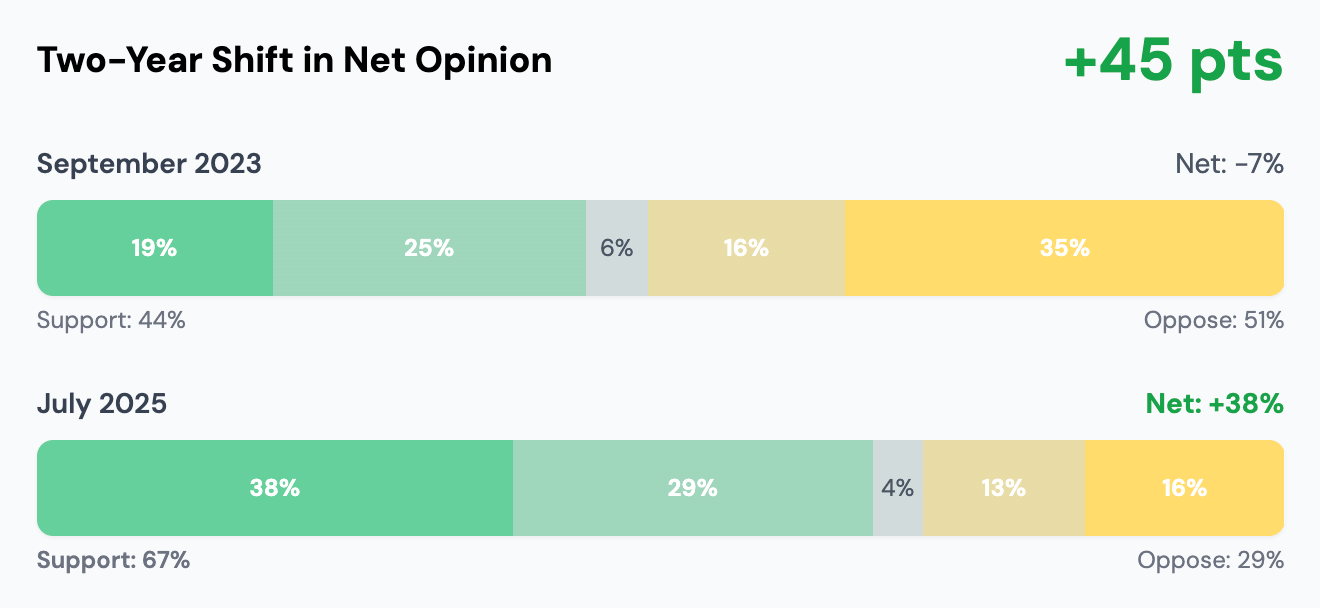
I haven’t found any decent polling around Oregonians’ interest (or lack thereof) in Waymo. In other cities, people have been pretty reticent about AVs prior to their rollout but then opinions shift positively as they get used to them.
But whether or not Oregonians want AVs today doesn’t much matter quite yet. Because today Waymo is illegal in Portland.
From Portland City Code 16.40:
Driver definition: Section 16.40.030(R) defines “driver” as “a person operating a PFHT [private for-hire transportation] vehicle”
License requirements: Sections 16.40.170 and 16.40.270 require all drivers to possess “a valid state-issued driver’s license”
Maximum Hours: Section 16.40.180 requires “No person may provide PFHT services after driving more than 12 hours in any given 24-hour period.”
There’s more where that comes from. Suffice to say, the PFHT code currently blocks Waymo from operating here.
At the state level it’s considerably less clear. It’s probably legal for Waymo to start testing in Oregon? From ODOT:
Oregon does not currently regulate AV testing, but the voluntary notification process allows ODOT to provide safety information to interested companies on work zones and lane closures on proposed test routes and dates
But most of the current rules predate AVs and there’s not really any case law here one way or the other. Oregon's vehicle code (ORS Title 59) implicitly assumes— but doesn’t explicitly require — human drivers. This ambiguity means driverless operation is neither clearly prohibited nor clearly authorized, which creates a legal risk for operators.
Were the market big or lucrative enough, Waymo might forge ahead anyway. But when the market is more marginal this sort of uncertainty could kill any chance they would want to take the risk, especially when they are already supply constrained.
A Quick Aside on the history of AV legislation in Oregon
How we got here is actually a good lesson in Oregon governance. In 2018, we enacted HB 4063 to designate ODOT as the lead for AVs and we set up a Task Force on Autonomous Vehicles. In 2019, the legislature considered House Bill 2770 which would have built out a framework for AV testing, permit fees, liability minimums, etc. This bill made it decently far through the lawmaking process but it was never actually put to a vote.
The Task Force on Autonomous Vehicles did produce a lengthy report in 2019 with dozens of recommendations. Then they quietly disbanded in 2021.
None of their recommendations were ever codified into law.
So that’s where we are. We created a committee to study it, we studied it, and…. nothing happened. Which leaves AVs in a strange legal limbo: neither legal nor illegal, where no one is willing to operate yet but, if one were to start, we wouldn’t be protected from any negligence or malfeasance. The worst of both worlds.4
So What’s Next?
When the Task Force put together their recommendations it was still 2019. The world has changed a lot in the subsequent 7 years. (Heck, Waymo still used safety drivers until 2020!) At the same time, a lot of their recommendations were pretty good. We just need to figure out how to implement them at the state level, and then navigate Portland’s regulatory framework for PFHT, work with the Port of Portland and then…
~ ~ record scratch ~ ~
Wait, what’s this? An HB4085 to legalize and regulate AVs? Introduced just this week in the 2026 legislative short session!!?!5
Let’s nerd out.
HB4085
Full text here.
Instant Reaction
Reading through, my immediate thought is: HB4085 looks like industry-friendly legislation to create a pathway for AVs. Furthermore, I think it’s better than the status quo but I don’t think it should be passed into law as written.
The Good
It resolves the legal ambiguities around what a “driver” is.
It creates a deployment pathway for AVs, not just a testing pathway.
It ensures a framework for first responder interactions.
The Bad
Section 8.2
…shall maintain a motor vehicle liability policy that provides combined single limit per occurrence third-party liability coverage of at least $1 million
California has a minimum liability of $5M per incident.
Washington has a minimum liability of $5M per incident during driverless testing.
Oregon’s 2019 Task Force recommended a minimum liability of $5M per incident.
Recommendation #1: we should increase the minimum liability from $1M per incident to $5M.
Section 10.6
Authorization granted…shall not expire unless suspended or revoked pursuant to section 12
And if you read section 12, suspending or revoking authorization is actually pretty difficult. With no expiration written into the statute either, ODOT’s hands are tied except in extreme cases.
Recommendation #2: ODOT should have wider leverage to revoke or suspend authorization, for patterns of risky behavior / traffic violations or for failures to submit the proper information (proof of insurance, collision reports, etc.)
In addition, we should consider some sort of sunset clause to ensure that ODOT periodically reaffirms each AV firm’s authorization to operate.
Section 7.2
…shall provide the Department of Transportation a copy of any collision report that the person is required to provide the National Highway Traffic Safety Administration…
This data sharing is necessary but it’s just not enough. There’s no requirements for data transparency around disengagement, on operational data, or much of anything else. California requires quarterly data reports and we should too.
Recommendation #3: AV operators should be required to share more data, on a quarterly basis. I’m not sure if it makes more sense to write this into statute or have ODOT write the regulations but regardless, I’d expect better data sharing with the state. I would want to see the following, at minimum a) vehicle miles traveled, disaggregated by vehicle, b) total trips with origin/destination by census tract c) all incidents including collisions, citations, and stoppage events where vehicle couldn’t complete the trip d) response times for requests for interventions by first responders.
The Controversial
There’s one last item that has already raised some hackles:
Section 13
A local government or local service district may not: (a) Prohibit the operation of an autonomous vehicle or on-demand autonomous vehicle network; (b) Impose a tax, fee, performance standard or other requirement specific only to the operation of an autonomous vehicle or on-demand autonomous vehicle network.
This is called local preemption. It would basically invalidate Portland City code 16.40 with respect to AVs, and prevent localities from adding on additional requirements or taxes.6
Sounds bad! Except…
State of Georgia law (e.g. Atlanta)
No rules or regulations relative to the operation of fully autonomous vehicles or automated driving systems shall be adopted which limit the authority to operate such vehicles or systems conferred by this Code section.
State of Texas law (e.g. Austin)
A political subdivision of this state or a state agency may not impose a franchise or other regulation related to the operation of an automated motor vehicle or automated driving system.
California is less explicit but the end result is the same: their state regulatory body handles AVs over any objections from localities.
In short: local preemption is the standard for AV rollout and adoption.
Which actually does make some sense to me. From a rider’s perspective, does matter if you’re in riding in Gresham or Portland or Troutdale? Shouldn’t they all function pretty much the same?
District 4 City Councilor Mitch Green disagrees with me. Per his quote to Bike Portland:
I oppose this bill’s effort to preempt our ability to locally regulate autonomous vehicles.
But, of course, local electeds are always going to want more control, not less.
I just don’t see the value in Portland going their own way here, given that it’s not the standard. We overcomplicate things enough as it is and I’d rather one, single, responsible regulating party — a.k.a. one neck to choke at ODOT — rather than a mosaic of overlapping regulations. I don’t have any interest in watching different layers of government all pointing fingers at each other when something goes wrong (or more likely, when nothing goes right in the first place).
Sins of Omission vs. Commission
So there we have it. A flawed bill7 that could be the harbinger of a much better future.
But I also want us to go into this clear-eyed. Some day Waymo is going to kill someone. No matter how good they are, it’s a matter of time. Just last week a Waymo hit a kid at in Santa Monica. In their telling:
The event occurred when the pedestrian suddenly entered the roadway from behind a tall SUV, moving directly into our vehicle’s path. Our technology immediately detected the individual as soon as they began to emerge from behind the stopped vehicle. The Waymo Driver braked hard, reducing speed from approximately 17 mph to under 6 mph before contact was made.
…
Following contact, the pedestrian stood up immediately, walked to the sidewalk, and we called 911.8
It’s so easy to visualize: a car driving along slowly, a kid runs out, the car slams brakes but can’t stop, kid gets hit. In this case, the kid was fine (thank God). And honestly? If their telling is accurate, the Waymo probably did better than I would have in that situation. But who knows? We’ll let the NHTSA investigation run its course and let them figure it out. Some day, though, some other kid somewhere else won’t be so lucky.
And no one — no politician, no regulator, no company exec is going to want to call the parents or go on TV and admit that they were the one that changed the law to allowed the car to operate. When it happens, they will get (rightly) raked over the coals.
But remember where we started this all? With those 39 traffic deaths last year? I think it’s instructive to hear about just one of the stories of what happened, of a father and son walking down the sidewalk.
The victim, 49-year-old DaRon Craig, was walking with his 12-year-old son when a speeding grey Ford Escape struck him and another pedestrian, killing him
…
Her son, being a firsthand witness, was eventually able to explain to his mom what happened.
“I was talking to Dad. I was right next to him […] We’re basically touching arms […] We were laughing about something, and I turned around and Dad was just gone.”
I didn’t know DaRon and I don’t know his son. But I’ve walked that stretch of MLK dozens of times. I go to that Safeway and to that Walgreens and to the bank down the block. His death, quite literally, hits close to home.
DaRon is dead because our laws and our roads make car crashes inevitable. He’s dead because our culture accepts car crashes as “accidents”, as something that happens, as normal, as all just part of the price of mobility. I’m sure no politician ever had to call DaRon’s son and tell him that; tell him that we choose to accept his dad’s death as the price of progress and because we’re too chickenshit to do better.
Motor vehicle accidents are the number one cause of death for ages 5 through 24.9 It doesn’t have to be this way. Waymo is 10x safer than humans today and I see no reason that won’t improve as they get more training data and as there are more of them on the road.
AVs alone10 won’t not solve the problem but they look to be the single best tool we have. So let’s figure out how to start using them rather than dither in committee for another half decade.
Final Thoughts + A Call to Action
Agree with me? Disagree with me? Whatever the case, now is the time to have your voice heard. Like, literally, in the next 72 hours. There is a public hearing schedule for Monday, Feb. 9th. Register to testify (or submit written testimony) here: https://olis.oregonlegislature.gov/liz/2026R1/Measures/Overview/HB4085
Alternatively, just reach out to your state rep. this week and tell them what you think. It only takes 2 minutes. Find your representative here: https://www.oregonlegislature.gov/FindYourLegislator/districts-initial.html
The national average is ~12 per 100k, but that’s because road deaths in rural areas are much more frequent. For a more like for like comparison, we do better than many cities of our size (Memphis, OKC, Baltimore, Denver) but worse than similarly urbanist, culturally comparable cities like Seattle and Minneapolis.
Service announced for 2026: Dallas, Denver Detroit, Houston, Las Vegas, Miami, Nashville, Orlando, San Antonio, San Diego, Seattle, Washington, DC. Additional cities with active Waymo driver testing: Baltimore, Boston, Minneapolis, New Orleans, New York City, Philadelphia, Pittsburgh, Sacramento, St. Louis, and Tampa. They are also talking expansion internationally, to London and Tokyo.
Full disclosure: I had Claude put together the model but I validated the inputs. It’s a toy model, not a real model; we’re blogging here, not making multimillion dollar investment decisions.
Or, in sassier terms: we have solved for an equilibrium where Elon Musk might operate but Waymo won’t.
Editor’s Note #1 — Oregon does this weird thing where in odd-numbered years we have a normal 160 day legislative session but then in even years we do a short, 35 day session. Don’t ask me to explain it; I can’t. This year the session will mostly be focused on budgets, transportation funding, and ICE.
Editor’s Note #2 — I had been writing this whole piece back in January and then some personal issues came up that delayed me finishing it, only to discover new movement and legislation afoot. Quite the fortuitous timing!
There is a carve out here for the airport, which is administered by the Port of Portland. I would expect the Port would need to update their rules around PTFH too, imposing different fees for AVs, and ensuring they are routed to the right spots. None of this is terribly complicated but I expect it to be a political fight (with Taxis, Ubers) and I hope that there isn’t a 2+ year delay, like they had in San Francisco where AVs couldn’t go to SFO for ages after their launch.
Even with my recommended edits there are still gaps — considerations around cybersecurity, around how arbitration is handled, around job displacement. But all of these are broader issues with AI and I don’t think we should derail this more focused bill over any one of them.
I hate the passive voice in press releases. So unbecoming.
Based on the latest data from the CDC, 2023
The investments we’ve been making in traffic safety will be just as additive in a world with AVs as one without. This includes — but is not limited to — speed cameras, road diets (like on SE Foster, NE Broadway), and improved crossings / “daylighting” infrastructure (like what’s being installed on NE Killingsworth).
Finally, of course, I would be remiss if I didn’t mention public transport. Trimet continues to provide our safest modes of transit.
Mort I appreciate you taking the time to research this and calling attention to the unnecessary traffic violence that occurs on Portlands streets. That said, you can put me in the disagree audience of this article.
The easiest solution to traffic violence as proven by Europe is a viable alternative to driving. Cars are dangerous at high speeds and when the infrastructure is designed for cars to move fast, bad things happen.
I'm a member of strong towns pdx, a local (very politically active) chapter of the national advocacy organization Strong Towns. In article linked below Chuck Mahron highlights something DOTs don't like to admit because it goes against the status quo: deaths during the pandemic went up because less people were driving, so there was less congestion and people could drive faster. As we have returned to "normal" congestion has returned and we have to drive slower.
https://archive.strongtowns.org/journal/2025/2/24/traffic-deaths-are-down-but-not-for-the-reasons-were-being-told
As a bike commuter and transit advocate myself i will say the streets are not safe enough for biking for a majority of the population and transit is woefully insufficient and inconvenient (plus we're defunding it). We have no VIABLE alternative to driving in Portland, so people drive. And deaths occur.
But we don't need more cars, or sketchy corporations to mediate our transportation needs. We just need our streets to be designed for alternatives to cars. And not just some, and not just painted lanes. We need to take advice from European countries that have proven Vision Zero is possible, i'm looking at you Sweden:
https://www.bbc.co.uk/future/article/20240517-vision-zero-how-europe-cut-the-number-of-people-dying-on-its-roads